
Crystal Z Campbell: Buffalo Spree
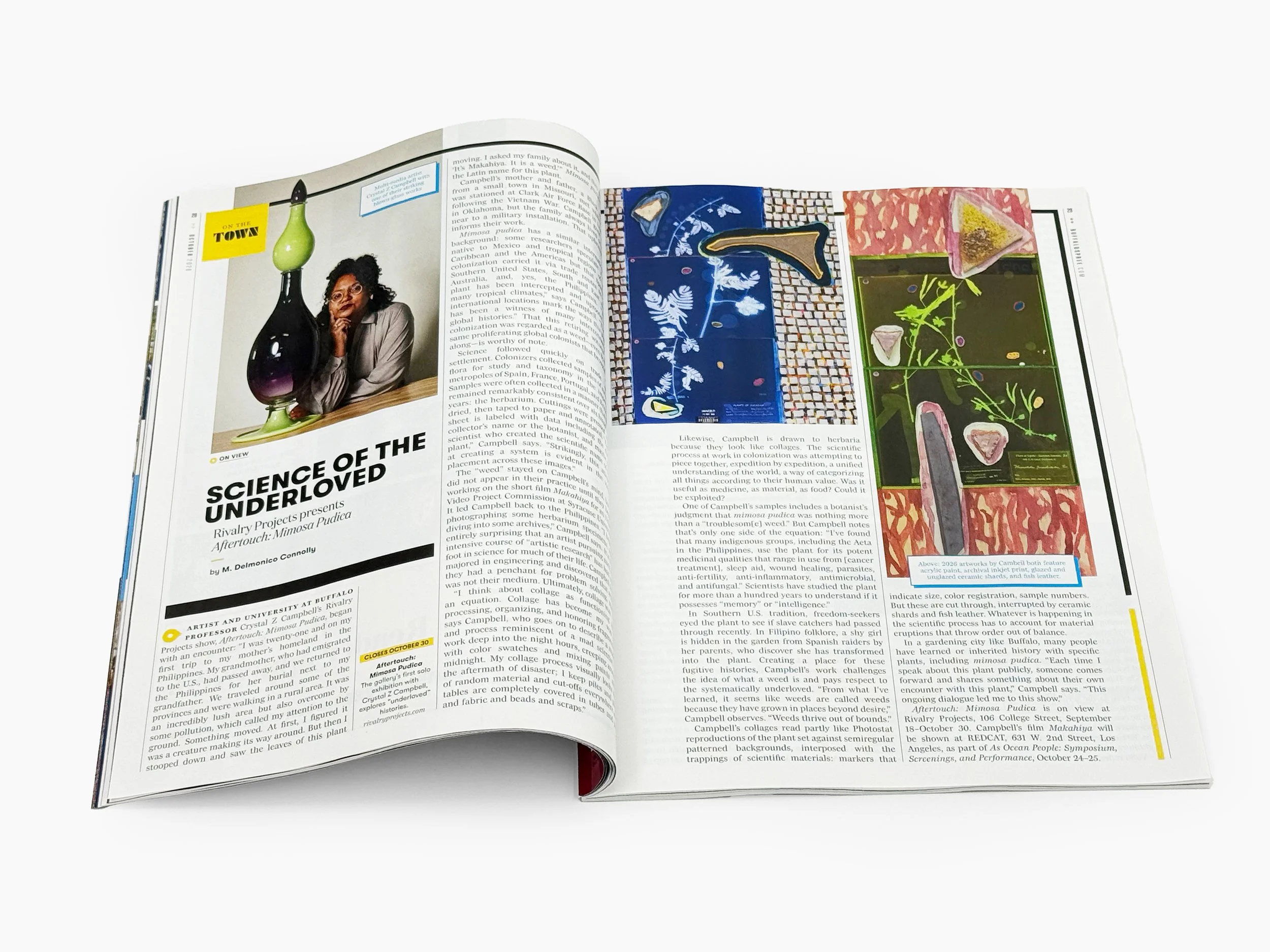
SCIENCE OF THE UNDERLOVED
Rivalry Projects presents Aftertouch: Mimosa Pudica
by M. Delmonico Connolly

SCIENCE OF THE UNDERLOVED
Rivalry Projects presents Aftertouch: Mimosa Pudica
by M. Delmonico Connolly
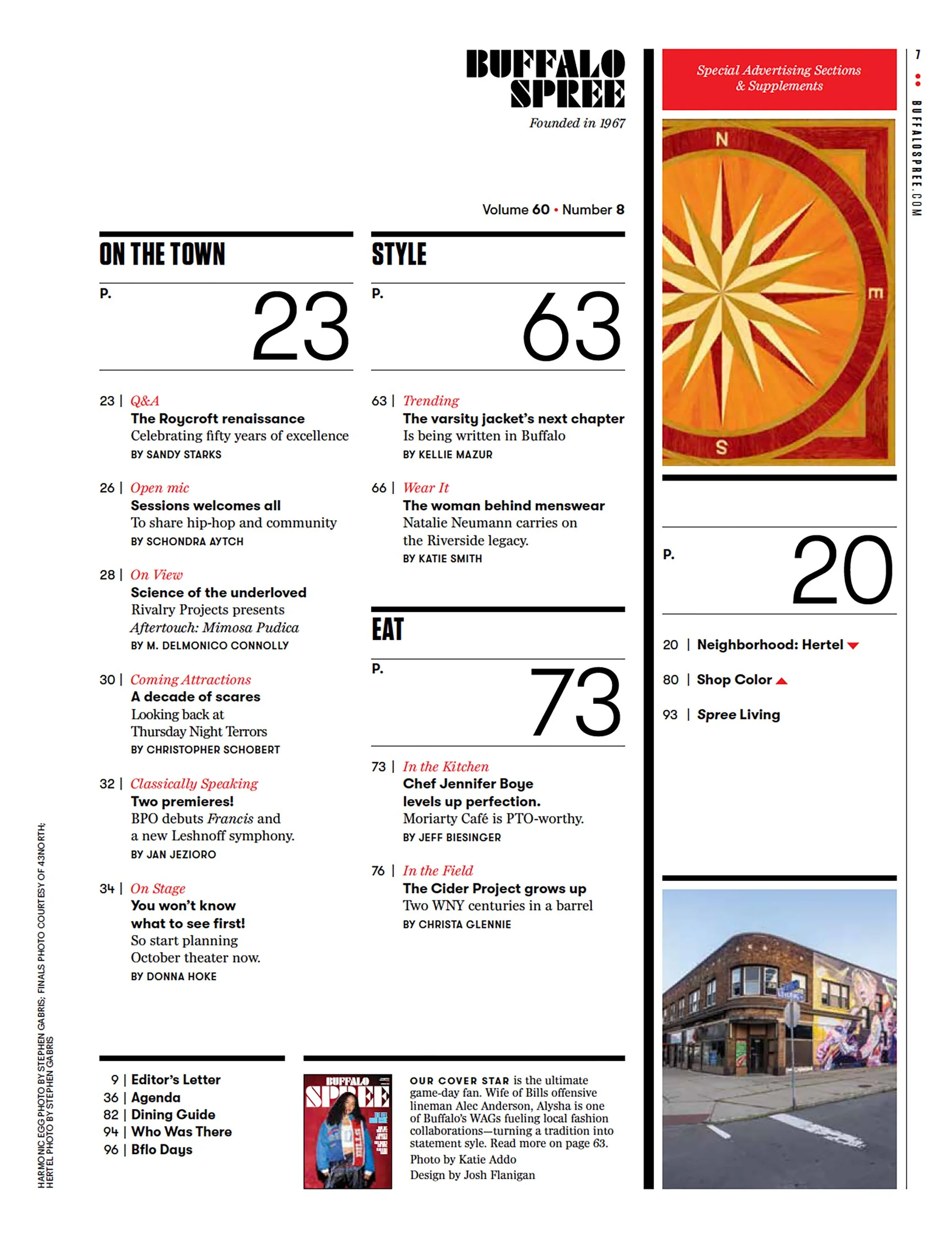
ARTIST AND UNIVERSITY AT BUFFALO PROFESSOR Crystal Z Campbell’s Rivalry Projects show, Aftertouch: Mimosa Pudica, began with an encounter: “I was twenty-one and on my first trip to my mother’s homeland in the Philippines. My grandmother, who had emigrated to the U.S., had passed away, and we returned to
the Philippines for her burial next to my grandfather. We traveled around some of the provinces and were walking in a rural area. It was an incredibly lush area but also overcome by some pollution, which called my attention to the ground. Something moved. At first, I figured it was a creature making its way around. But then I stooped down and saw the leaves of this plantmoving. I asked my family about it, and they said ‘It’s Makahiya. It is a weed.’” Mimosa pudica is the Latin name for this plant. Campbell’s mother and father, a Black man from a small town in Missouri, met while he was stationed at Clark Air Force Base in Luzon following the Vietnam War. Campbell grew up in Oklahoma, but the family always lived on or near to a military installation. That upbringing informs their work.
Mimosa pudica has a similar international background: some researchers speculate it is native to Mexico and tropical regions of the Caribbean and the Americas but that Spanish colonization carried it via trade routes to the Southern United States, South and East Asia, Australia, and, yes, the Philippines. “This plant has been intercepted and uprooted in many tropical climates,” says Campbell. “These international locations mark the ways this plant has been a witness of many interconnected global histories.” That this retiring witness to colonization was regarded as a weed—even by the same proliferating global colonists that brought it along—is worthy of note.
Science followed quickly on trade and settlement. Colonizers collected samples of native flora for study and taxonomy in the imperial metropoles of Spain, France, Portugal, and Britain. Samples were often collected in a manner that has remained remarkably consistent over six hundred years: the herbarium. Cuttings were pressed and dried, then taped to paper and annotated. “Each sheet is labeled with data including the date, collector’s name or the botanist, and maybe the scientist who created the scientific name of the plant,” Campbell says. “Strikingly, this attempt at creating a system is evident in the visual placement across these images.”
The “weed” stayed on Campbell’s mind, but it did not appear in their practice until they began working on the short film Makahiya for an Urban Video Project Commission at Syracuse University. It led Campbell back to the Philippines. “I began photographing some herbarium specimens, and diving into some archives,” Campbell says. It is not entirely surprising that an artist pursuing such an intensive course of “artistic research” has had one foot in science for much of their life. Campbell first majored in engineering and discovered that while they had a penchant for problem solving, math was not their medium. Ultimately, collage was.
“I think about collage as functioning like an equation. Collage has become my way of processing, organizing, and honoring fragments,” says Campbell, who goes on to describe a studio and process reminiscent of a mad scientist. “I work deep into the night hours, creeping around with color swatches and mixing paints after midnight. My collage process visually looks like the aftermath of disaster; I keep piles and piles of random material and cut-offs everywhere and tables are completely covered in tubes and jars and fabric and beads and scraps.”
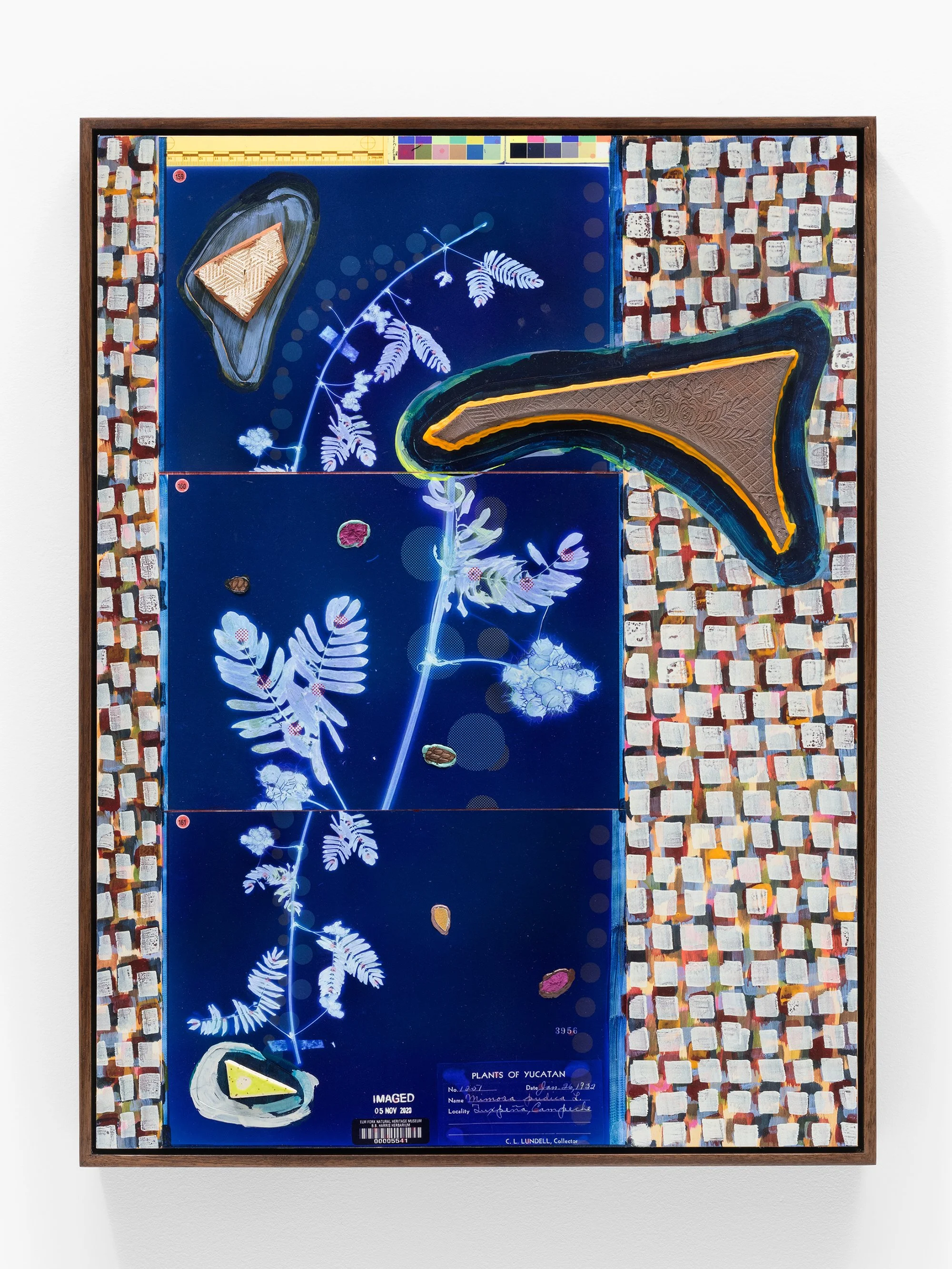
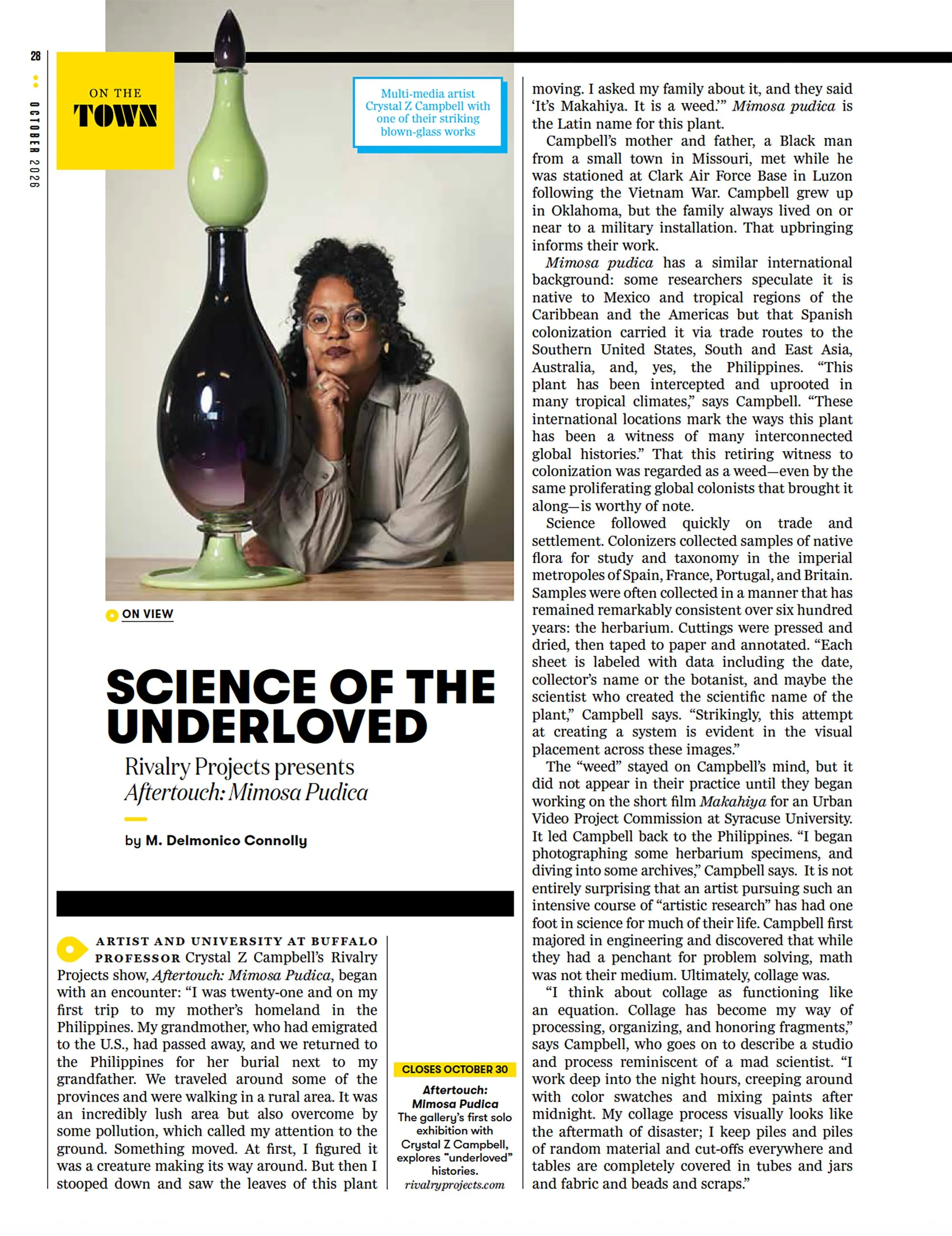
Mimosa Pudica: Yucatan, Mexico, 2026
Acrylic paint, archival inkjet print, glazed and unglazed ceramic shards, fish leather, leather, beads, on birch wood panel, 24 x 18 inches, 24.75 x 18.75 inches, framed
Likewise, Campbell is drawn to herbaria because they look like collages. The scientific process at work in colonization was attempting to piece together, expedition by expedition, a unified understanding of the world, a way of categorizing all things according to their human value. Was it useful as medicine, as material, as food? Could it be exploited?
One of Campbell’s samples includes a botanist’s judgment that mimosa pudica was nothing more than a “troublesom[e] weed.” But Campbell notes that’s only one side of the equation: “I’ve found that many indigenous groups, including the Aeta in the Philippines, use the plant for its potent medicinal qualities that range in use from [cancer treatment], sleep aid, wound healing, parasites, anti-fertility, anti-inflammatory, antimicrobial, and antifungal.” Scientists have studied the plant for more than a hundred years to understand if it possesses “memory” or “intelligence.”
In Southern U.S. tradition, freedom-seekers eyed the plant to see if slave catchers had passed through recently. In Filipino folklore, a shy girl is hidden in the garden from Spanish raiders by her parents, who discover she has transformed into the plant. Creating a place for these fugitive histories, Campbell’s work challenges the idea of what a weed is and pays respect to the systematically underloved. “From what I’ve learned, it seems like weeds are called weeds because they have grown in places beyond desire,” Campbell observes. “Weeds thrive out of bounds.”
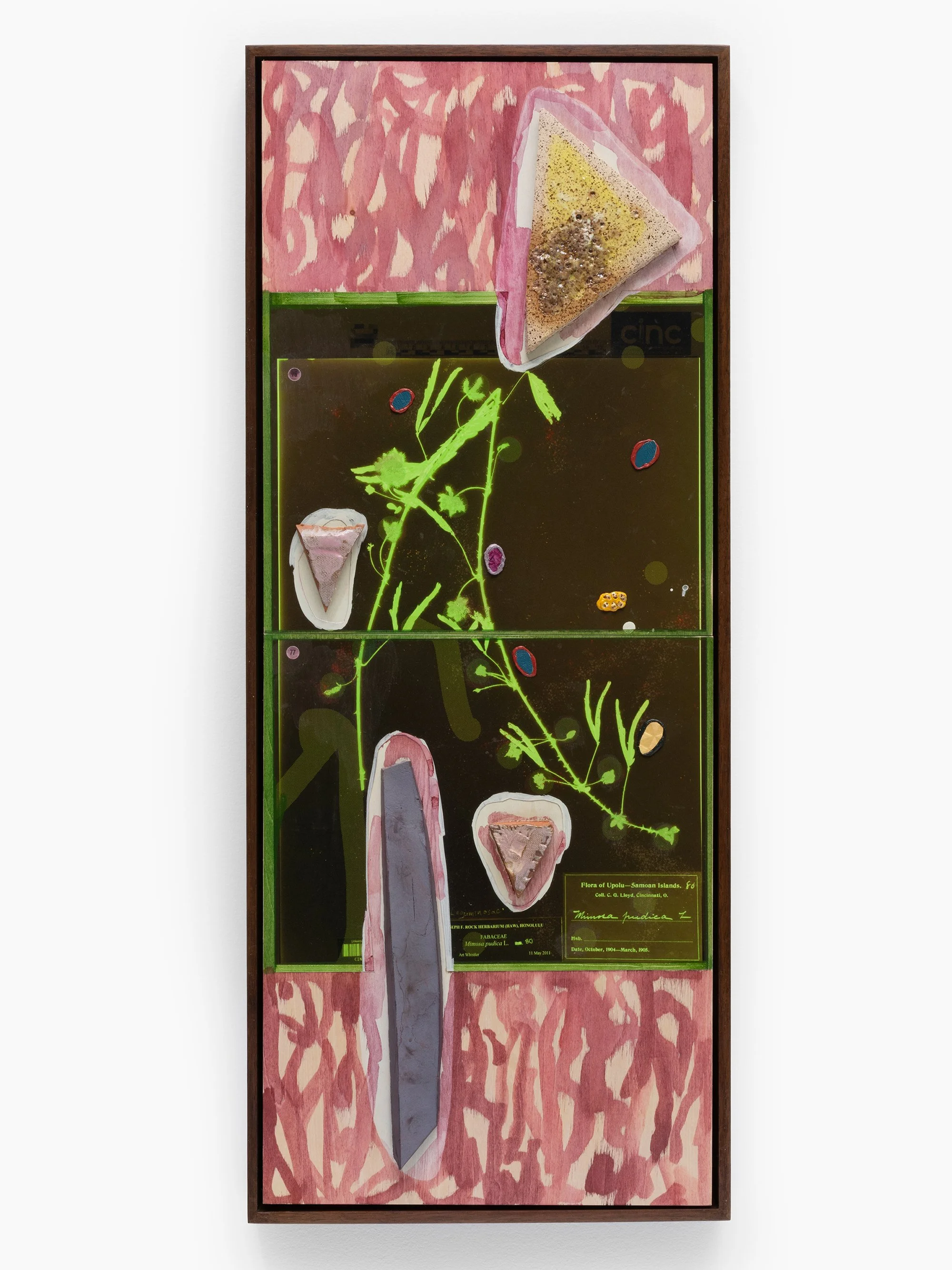
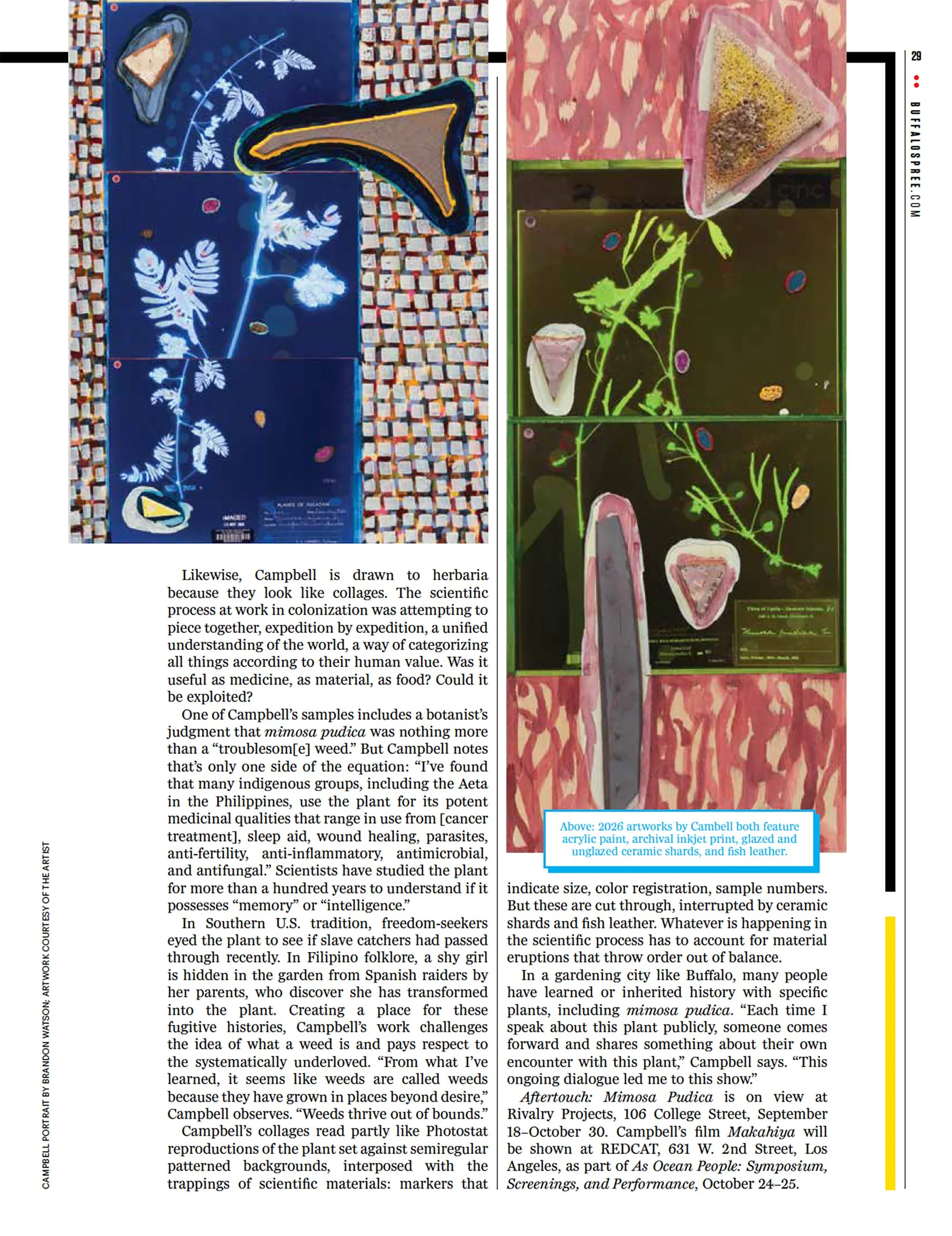
Mimosa Pudica: Samoan Islands, 2026
Acrylic paint, archival inkjet print, unglazed ceramic shards, homegrown crystals on birch wood panel,
28 x 11 inches, 28.75 x 11.75 inches, framed diptych
Campbell’s collages read partly like Photostat reproductions of the plant set against semiregular patterned backgrounds, interposed with the trappings of scientific materials: markers that indicate size, color registration, sample numbers. But these are cut through, interrupted by ceramic shards and fish leather. Whatever is happening in the scientific process has to account for material eruptions that throw order out of balance.
In a gardening city like Buffalo, many people have learned or inherited history with specific plants, including mimosa pudica. “Each time I speak about this plant publicly, someone comes forward and shares something about their own encounter with this plant,” Campbell says. “This ongoing dialogue led me to this show.”
Aftertouch: Mimosa Pudica is on view at Rivalry Projects, 106 College Street, September 18–October 30. Campbell’s film Makahiya will be shown at REDCAT, 631 W. 2nd Street, Los Angeles, as part of As Ocean People: Symposium, Screenings, and Performance, October 24–25.